
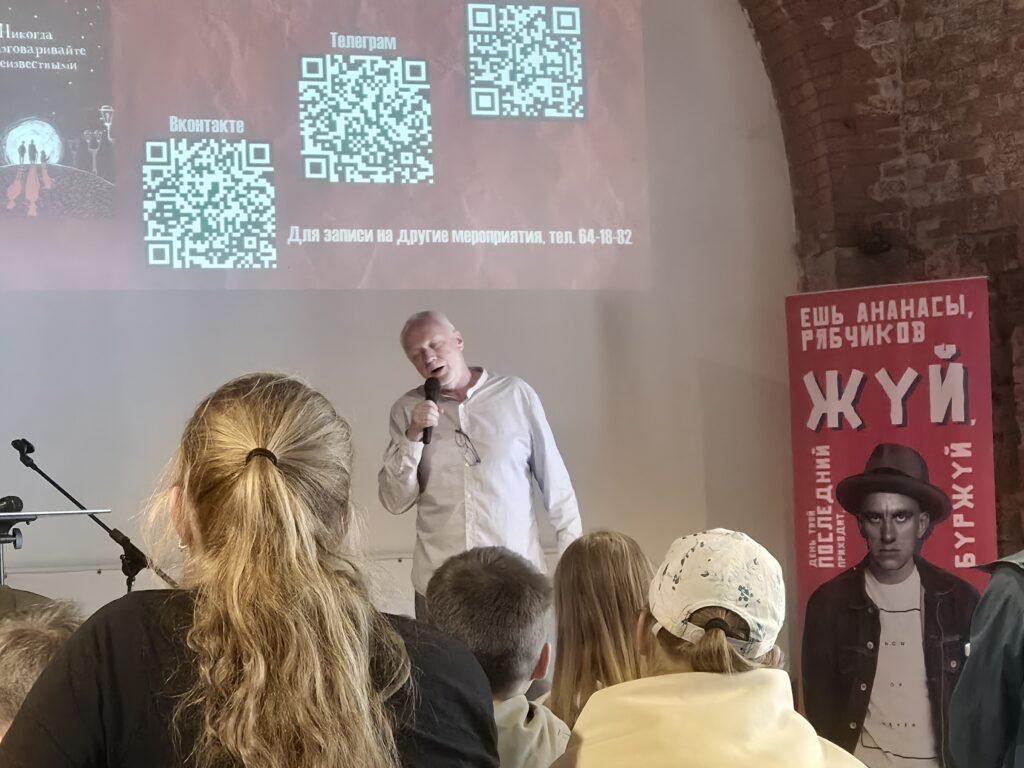
End of Summer festival at Kaliningrad’s Mayakovsky Library yesterday. Strange to discuss contemporary horror fiction in a building named after a poet who made his own life into performance art.
The panel topic was interactive literature and reader participation. Fitting venue – Mayakovsky understood that art should demand response, should refuse to let audiences remain passive. His poetry was confrontational, designed to provoke rather than comfort.
Been thinking about his approach to revolutionary art – poetry that demanded participation, that refused to let audiences remain comfortable observers. What happens when artistic vision meets social reality? How do you maintain creative integrity whilst engaging with systems of power?
My work explores similar territories through different methods. Interactive fiction forces readers to become accomplices rather than observers. Mayakovsky used shock and provocation; I use psychological manipulation and moral complexity. Different tools, same goal – making literature an active experience.
The audience questions were sharp. One reader asked whether my memory-manipulation themes connect to Soviet experiences of historical erasure. Valid comparison. When state power controls collective memory, individual memory becomes resistance.
Another mentioned Mayakovsky’s relationship with propaganda versus artistic truth. He championed the revolution whilst maintaining his avant-garde vision. Similar tensions exist in interactive fiction – do you give readers what they want or what they need to understand?
The Maw launches in two months. Been wondering whether contemporary audiences can handle the psychological pressure I’m building into those choice structures. Mayakovsky believed art should be a weapon. Mine’s designed to be a mirror.
Revolutionary art never goes out of style. It just finds new forms.
Daria Ryzhikova Writer