
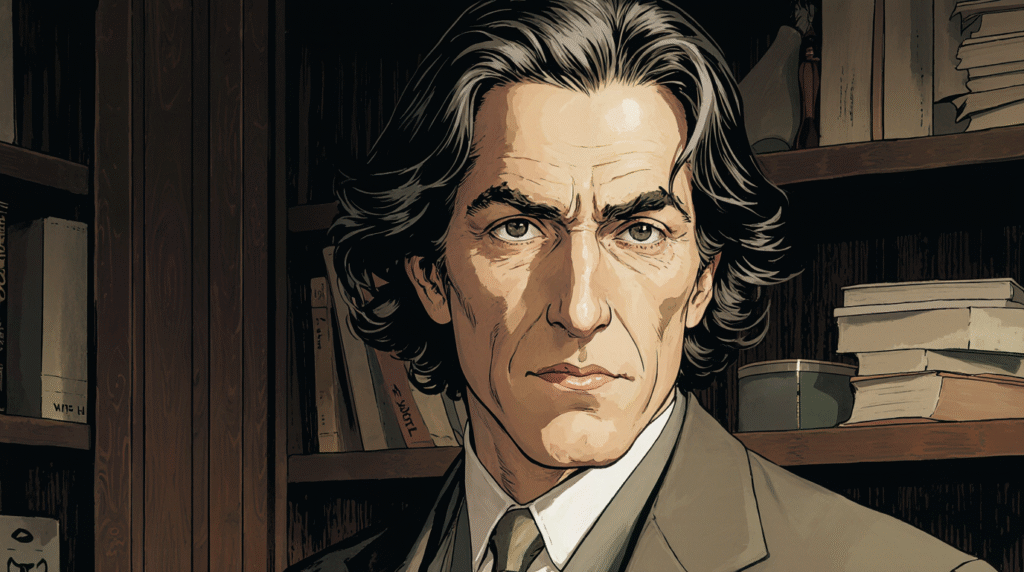
Meet Saul Duskvale, Director of the Sunset Centre. Fifty-something, imposing presence, the kind of man who commands a room simply by entering it. Dark hair touched with silver, amber eyes that have seen too much, always impeccably dressed even at home.
Saul built the Centre from nothing, transforming it into the premier research facility for consciousness studies in alternative 1925. A brilliant neuroscientist turned administrator, he represents the establishment that the Thorne brothers work within.
But authority built on control has its blind spots.
His surname Duskvale, “valley of dusk,” connects directly to his life’s work. The Centre operates in the liminal space between consciousness and unconsciousness, memory and forgetting. Fitting for a man who increasingly finds himself caught between light and shadow.
Saul lost his wife Alice during childbirth, leaving him to raise their child alone. That loss shaped his approach to everything: meticulous control, careful planning, the belief that if you manage every variable, you can prevent tragedy. He pours his love into his work and his remaining family with the intensity of someone who cannot afford another loss.
The biblical Saul was the first king of Israel who lost divine favour. My Saul faces a different kind of fall from grace. What happens when someone who has built their life on being right discovers they’ve been catastrophically wrong?
In a story about memory manipulation, the most dangerous blindness might be refusing to see the people closest to you clearly.
Mneme releases next week. Sometimes the most powerful people are the most fragile.
Daria Ryzhikova Writer